
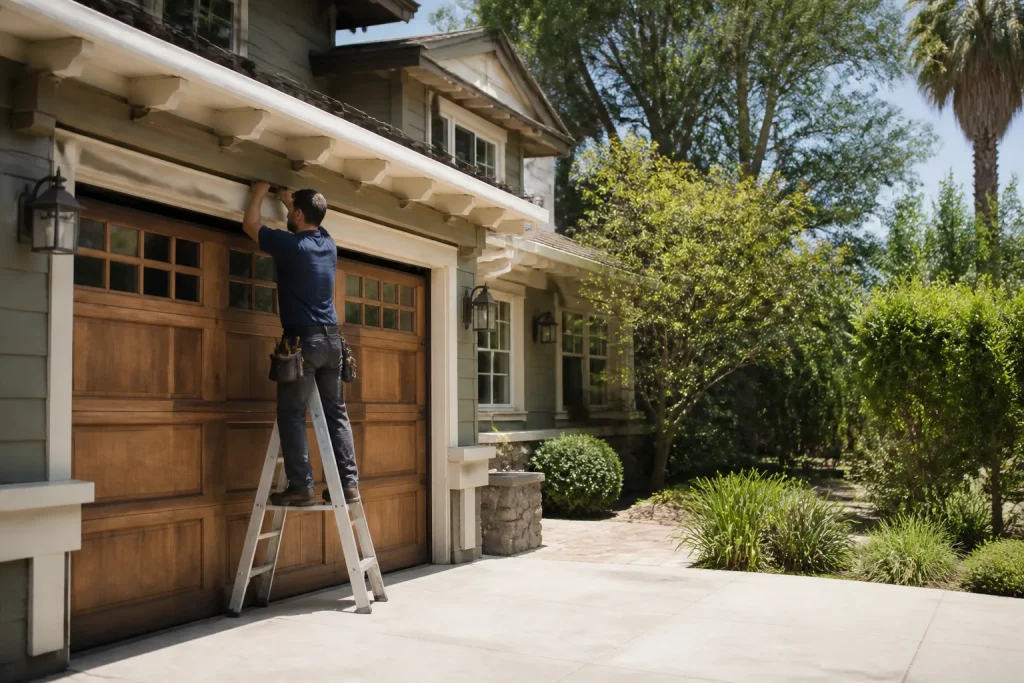
LiftMaster Garage Door Repair in Pasadena: A Homeowner’s Guide
LiftMaster garage door repair in Pasadena usually means one of three things: a logic board that’s locked itself out, a safety sensor pair knocked out of alignment, or a travel module that’s forgotten its limits. None of these require a new opener, and most of them are same-day fixes. If you’d rather skip the diagnosis and just get it handled, call us at (855) 740-8388.
We pulled a LiftMaster 8500W out of a garage over in Bungalow Heaven last month where the homeowner had been told by another company she needed a full logic board replacement, $220 for the part alone. The actual problem was a MyQ hub firmware mismatch that took forty minutes to resolve. She’d been without a functioning door for four days over a software handshake. That’s the exact scenario this guide exists to prevent.
Where most online advice goes wrong is treating a LiftMaster like a generic chain-drive opener from 2004. It isn’t. Since Chamberlain consolidated the LiftMaster line around the MyQ platform, every repair decision you make needs to account for the connectivity layer sitting on top of the mechanical components. Miss that layer, and you’ll pay for a fix that doesn’t fix anything.
Here’s what Pasadena homeowners actually need to know about LiftMaster repair, from error codes to California-specific quirks to the warranty realities nobody puts on the brochure.
Key Takeaways
- Most LiftMaster “logic board failures” in Pasadena are actually MyQ communication errors or lockout states, not dead hardware.
- California’s Title 24 battery backup requirements mean certain LiftMaster units have a replacement calculus that differs from the rest of the country.
- LiftMaster safety sensor faults are frequently caused by force-setting drift, not physical sensor damage.
- Warranty claims hinge on who installed the unit and whether the MyQ ecosystem stayed intact, which most Pasadena homeowners don’t realize until a claim gets denied.
- You don’t always need a LiftMaster specialist, but you do need a tech who understands the MyQ layer. We work on LiftMaster every week alongside Chamberlain, Genie, and the rest of the major brands.
How the MyQ Connectivity Layer Changes LiftMaster Repair Decisions
LiftMaster has shipped almost every residential opener it makes with some version of MyQ since roughly 2018. That matters for repair because the opener now has two failure domains: the mechanical assembly that moves the door, and the smart-home layer that tells it when to move. A homeowner in Pasadena who calls about a door that won’t respond to the wall button but still opens fine from the app isn’t describing a mechanical failure. They’re describing a communication failure between the wall console and the logic board’s receiver module.
Here’s what that means practically. If your LiftMaster refuses the wall button, the MyQ app, or the keypad but spins the motor when you jumper the terminals, the door mechanics are fine. The problem is in the receiver, the wall console’s encrypted signal path, or a lockout state triggered by too many failed authentication attempts. None of those require a new motor. All of them can be misdiagnosed as a failed logic board by a tech who doesn’t know the difference.
In our experience, three out of five LiftMaster service calls in Pasadena that arrive with a “bad board” diagnosis from another company turn out to be something else. Sometimes it’s a wall console that needs re-pairing. Sometimes it’s a security lockout that clears by power-cycling the unit at the breaker for a full ninety seconds, not the thirty-second toggle most people try. Sometimes it’s a failing capacitor on the control board that costs under $40 to replace rather than the $180 logic board replacement quoted.
The takeaway: before you approve any LiftMaster logic board replacement, ask the technician to show you the LED diagnostic code and explain what it means. If they can’t read the code off the board, they’re guessing. We read codes. It’s half the job.
Working on LiftMaster since the MyQ transition also means we understand how it plays with other brands on the same rail system. A Craftsman opener from the pre-Chamberlain merger era shares enough DNA with early LiftMaster designs that certain parts interchanges are straightforward. A Raynor unit has its own logic quirks. The Stonewall Garage Door Repair home covers all of it under one roof, which means you’re not running a second service call for a second brand.
California Title 24 and the Battery Backup Question
Since July 2019, California’s Title 24 building efficiency standards have required that any newly installed residential garage door opener include battery backup. LiftMaster complies with this through its integrated battery units on models like the 8550W and 8160WB, plus add-on battery kits for others. For Pasadena homeowners, this creates a repair-vs-replace decision that doesn’t exist in other states.
Here’s the reality. Many LiftMaster openers installed in Pasadena before 2019 don’t have battery backup. If one of those units suffers a major failure, say a stripped gear assembly or a burned drive motor, you’re not legally required to add battery backup to the repaired unit. But the moment you replace the entire opener, the new install must include battery backup under Title 24. That changes the math. A $180 gear-and-sprocket replacement on a pre-2019 unit might be the better financial decision than a $550 full replacement with battery backup, even if the old unit is ten years old.
The exception is when the pre-2019 unit is also pre-MyQ. At that point, you’re running a disconnected opener in a connected city. Pasadena sees a lot of these because the housing stock skews older, and a 2008 LiftMaster Security+ 2.0 unit still opens and closes a door fine. But it can’t integrate with Amazon Key, can’t give you remote monitoring, and can’t accept the newer encrypted remotes. When that’s the case, replacement often wins.
Another California-specific issue: battery backup units that sit through Pasadena’s hot summers degrade faster than LiftMaster’s published lifespan suggests. The manufacturer rates the battery at one to three years depending on usage cycles. In our experience, units installed in garages that regularly hit 100 degrees in August trend toward the low end of that range. If your opener is beeping twice every thirty seconds, that’s the battery failure alert, not a door problem. Fix is a battery swap, not a service call for the opener itself.
For homeowners weighing replacement, this is where the Garage Door Installation in Pasadena conversation matters. You want a full accounting of what Title 24 means for your specific house, not a generic opener swap.
Which LiftMaster Owners Actually Need a Specialist
Not every LiftMaster problem requires a specialist. A broken spring on a standard torsion system is a broken spring regardless of what brand name is on the opener motor. Any competent Garage Door Repair in Pasadena tech can handle that. Same goes for roller replacement, cable work, and track alignment.
Where specialist knowledge actually pays off is the MyQ-equipped units from roughly 2018 forward. Here’s the dividing line that matters:
- Security+ 315MHz or 390MHz units (roughly 2005-2017): Simpler control boards, no app integration, well-documented repair paths. A general opener tech with a decent parts supplier can handle most failures. You’re paying for mechanical competence, not brand-specific knowledge.
- MyQ-ready and MyQ-integrated units (2018 to present): These units have encrypted serial communication between the wall console, the logic board, and the MyQ hub. Diagnosis requires understanding which component is talking and which one isn’t. This is where the misdiagnosis problem lives. If your LiftMaster is under six years old and has Wi-Fi, you want someone who works on it regularly.
- Commercial and jackshaft units (8500, 8500W, RJO series): Jackshaft openers are a different animal entirely. They mount on the wall, drive the torsion bar directly, and use a cable tension monitor instead of a safety sensor pair. The failure modes are different, the adjustment procedures are different, and a tech who learned on chain-drive residential units will struggle. Pasadena has plenty of these in converted garages and ADUs.
The smartest question you can ask a prospective repair company is: “How many MyQ LiftMaster units have you worked on this month?” If the answer is vague, keep looking. We see them weekly, which is why we can diagnose over the phone accurately before we even arrive.
The Safety Sensor Problem Everyone Misdiagnoses
LiftMaster openers manufactured since around 2016 ship with a close-force profile that’s more aggressive than older Chamberlain units. The motor drives the door down with tighter tolerance, and the optical safety sensors carry a heavier diagnostic load. When a Pasadena homeowner gets a door that reverses right before closing, or a sensor LED that blinks but won’t stay solid, the reflex diagnosis from a general tech is “bad sensor.”
It’s usually not the sensor.
What happens more often is that the close-force setting has drifted from the factory spec, usually because the travel module lost its limits after a power surge or a battery backup transition. When force settings drift, the opener interprets normal resistance as an obstruction and reverses. If the tech misreads that as a sensor fault, they’ll replace a $35 sensor pair and leave the real problem untouched. The door might work for a week because replacing the sensors forces a relearn cycle, then the drift reasserts itself and the problem returns.
Another LiftMaster-specific issue: the safety sensors are polarity-sensitive in a way older Chamberlain sensors weren’t. If the wiring to the sensors gets reversed, even briefly, the opener can log a sensor fault that persists until the unit is fully power-cycled and the sensors re-taught. We’ve seen Pasadena garages where a homeowner swapped sensors themselves, mixed up the white and white-with-black-stripe wires, and spent a weekend convinced they’d bricked the unit. Ten minutes of re-termination and a relearn fixed it.
The reason this matters to repair economics is straightforward: a misdiagnosed sensor fault often escalates into an unnecessary logic board replacement if the first “fix” doesn’t hold. You pay twice. The right fix the first time is always cheaper.
Related: for sensor-lens damage, sun interference at certain angles in Pasadena’s late afternoon light, or a door that still reverses after the sensors check out, the mechanical side of the system is usually the culprit. That’s a regular part of our Garage Door Opener Repair in Pasadena work.
LiftMaster Warranty Reality: What Actually Gets Covered in Pasadena
LiftMaster’s official warranty language sounds generous: lifetime motor warranty on belt and chain drive units, five years on parts for most models, one year on accessories and batteries. The fine print is where Pasadena homeowners get caught.
First, the lifetime motor warranty applies to the homeowner who purchased the opener from an authorized dealer and had it professionally installed. If you bought a LiftMaster opener from a big-box store and installed it yourself, or had a handyman do it, the motor coverage drops to the standard parts window. In practice, that means a motor failure on year seven gets denied.
Second, LiftMaster warranty claims require the opener to still communicate with its original MyQ ecosystem where applicable. If the unit has been disconnected from MyQ, had its radio module swapped, or been locked out by a lost account credential, the warranty claim gets flagged. We’ve seen claims denied because the homeowner changed Wi-Fi networks, the MyQ hub lost registration, and the opener’s error log showed a communication fault the manufacturer attributed to owner tampering.
Third, battery backup units have their own warranty track. The integrated battery on an 8550W is covered for one year. Not three, not five. One. Pasadena’s heat pushing batteries to fail at the eighteen-month mark means a lot of homeowners discover this coverage gap exactly when they need it most.
What this means for your repair decision: if you’re inside the warranty window, make the call. LiftMaster’s support line will ask for the serial number, the date of installation, and the dealer who sold it. Have that ready. If you’re outside the window, the repair path is often cheaper than the replacement path, especially for mechanical failures on pre-2020 units that haven’t hit their end-of-life.
We’ve worked on enough LiftMaster units across Pasadena to tell you where the reliable repair paths are and where the manufacturer’s coverage actually stops. That’s the kind of knowledge that saves you a $400 misstep.
When to Call a Pro
Some LiftMaster issues are safe to diagnose yourself: a dead remote battery, a misaligned sensor you can see with your own eyes, a door that reverses because a broom fell against the track. But the moment the problem involves high-tension torsion springs, frayed cables, or a logic board that’s showing codes you don’t recognize, stop poking at it. Torsion springs under load store enough energy to cause serious injury or death if they release wrong. We replace them with the door locked down and the spring tensioned properly, not improvised in a driveway with a pair of vice grips.
Same goes for any repair that requires you to bypass a safety sensor or force a travel limit. Those systems exist because garage doors weigh several hundred pounds. A door that comes down on a car, a pet, or a person isn’t worth the $150 you saved on a service call.
If you’re in Pasadena and your LiftMaster is doing something you can’t explain, describe it to us over the phone first. We can often tell you whether it’s a five-minute fix you can do yourself or a genuine service call. That’s how a specialist behaves: same expertise either way, no charge for the five-minute answer.
The Bottom Line
LiftMaster is the most-installed opener brand in Pasadena, which makes it the most-misdiagnosed. The MyQ layer means your opener has two brains now, a mechanical one and a digital one, and technicians who don’t understand the second one will waste your money chasing the first one. California’s Title 24 adds another wrinkle: battery backup requirements that change your repair-versus-replace math in ways that don’t apply to homeowners in other states. And the warranty protection you think you have may not survive contact with the fine print.
That’s what we handle at Stonewall Garage Door Repair in Pasadena. We work on LiftMaster constantly, we know the MyQ ecosystem cold, and we’ll tell you straight whether your opener needs a $40 part or a full replacement. No board-swap guessing, no unnecessary upselling. If you’re in Pasadena and your opener’s acting up, call (855) 740-8388 for a free estimate. We’ll quote the price before any work starts, and that’s the price you’ll pay.
Frequently Asked Questions
LiftMaster repair costs in Pasadena typically range from $120 to $350 depending on the failure. A sensor realignment or wall console re-pairing runs at the low end. A gear-and-sprocket replacement on a chain-drive unit runs higher. Logic board replacements, when genuinely needed, land at the top of that range. Any company quoting a board replacement should show you the diagnostic code first. Call (855) 740-8388 for a specific quote on your unit, and we’ll give you the number before we touch anything.
That pattern means the door mechanics and motor are fine, but the wall console has lost its encrypted pairing with the opener’s receiver, or the unit is in a security lockout after too many failed signal attempts. It’s almost never a dead logic board. A power cycle at the breaker for a full ninety seconds often clears the lockout, but persistent pair failures usually mean the console itself needs replacement or re-programming.
If you’re replacing the entire opener, yes, California Title 24 requires battery backup on new residential installations. If you’re repairing an existing opener installed before 2019, you can keep running without it. The decision hinges on whether you want MyQ connectivity and remote monitoring. For help with the calculus, call (855) 740-8388 and we’ll walk you through what your specific situation requires.
Often not. LiftMaster units from 2016 onward are prone to close-force drift after power interruptions, which makes the opener misread normal resistance as an obstruction. A tech who jumps straight to sensor replacement may not fix the underlying issue. Before you pay for parts, ask for the stored diagnostic codes and a force-setting check. That costs nothing to run and tells us whether you need a sensor pair, a force relearn, or something else entirely.
Written by the team at Stonewall Garage Door Repair, serving Pasadena since 2013.
Need Garage Door Help?
Call Stonewall Garage Door Repair — licensed & insured, here with fast after-hours help in Pasadena.
(855) 740-8388